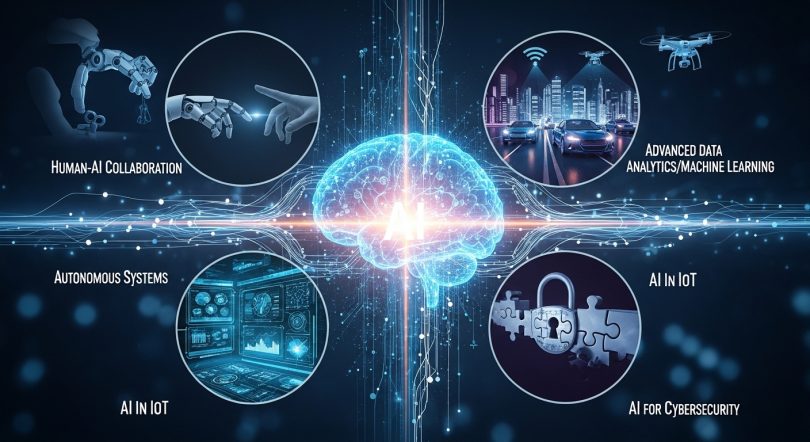

Artificial intelligence is rapidly transforming the global technology landscape by reshaping how businesses operate, how people interact with systems, and how decisions are made across industries. From automation to advanced machine learning models, AI is becoming deeply integrated into everyday digital tools. These trends are not only improving efficiency but also defining the future direction of innovation, productivity, and intelligent systems worldwide.
Generative AI Revolution
Content Creation Automation
Generative AI is revolutionizing content creation by producing text, images, videos, and code with minimal human input. It helps businesses scale marketing, design, and communication tasks efficiently. This technology is reducing production time while increasing creativity and personalization in digital content across industries.
AI Powered Design Tools
AI-powered design tools assist creators in building visuals, logos, and user interfaces quickly. These systems analyze patterns and user preferences to generate optimized designs. They improve productivity for designers and allow non-experts to create professional-quality digital assets easily.
Intelligent Writing Systems
Intelligent writing systems use AI to generate articles, emails, and reports with human-like quality. They support professionals by improving grammar, tone, and structure. This trend is reshaping content industries and enhancing productivity in digital communication.
Video Generation Technology
AI video generation technology creates realistic videos from text or images. It is widely used in marketing, education, and entertainment. This innovation reduces production costs and enables faster content delivery across digital platforms.
Creative AI Collaboration
Creative AI collaboration involves humans and AI working together to produce innovative solutions. It enhances creativity, speeds up workflows, and supports industries like advertising, media, and software development.
Machine Learning Advancement
Predictive Analytics Growth
Predictive analytics uses machine learning to forecast trends and outcomes based on data. Businesses use it for decision-making, risk analysis, and customer insights. It improves accuracy and supports strategic planning in competitive markets.
Deep Learning Expansion
Deep learning models mimic human brain functions to process complex data. They are used in image recognition, speech processing, and autonomous systems. This technology is driving major breakthroughs in AI capabilities.
Automated Decision Systems
Automated decision systems use AI to make real-time decisions without human intervention. They are widely used in finance, healthcare, and logistics to improve speed and accuracy.
AI Pattern Recognition
AI pattern recognition identifies trends in large datasets. It helps detect fraud, analyze behavior, and improve system performance. This technology is essential for modern data-driven industries.
Self Learning Algorithms
Self-learning algorithms continuously improve their performance by analyzing new data. They reduce the need for manual updates and enhance system intelligence over time.
AI in Business Transformation
Smart Business Automation
Smart automation uses AI to handle repetitive business tasks such as data entry and customer support. It increases efficiency and reduces operational costs.
Customer Experience AI
AI enhances customer experience through personalized recommendations, chatbots, and predictive support systems. It improves satisfaction and engagement across digital platforms.
AI Driven Marketing
AI-driven marketing analyzes customer behavior to create targeted campaigns. It improves conversion rates and helps businesses reach the right audience effectively.
Financial AI Systems
Financial AI systems are used for fraud detection, investment analysis, and risk management. They improve accuracy and speed in financial decision-making processes.
Supply Chain Optimization
AI optimizes supply chains by predicting demand, managing inventory, and reducing delays. It improves efficiency and reduces operational costs for businesses.
AI in Healthcare Innovation
Medical Diagnosis AI
AI assists doctors in diagnosing diseases using medical data and imaging. It improves accuracy and supports early detection of health conditions.
Drug Discovery Systems
AI accelerates drug discovery by analyzing biological data and predicting treatment outcomes. It reduces research time and improves medical innovation.
Patient Monitoring Technology
AI-powered monitoring systems track patient health in real time. They help detect abnormalities and improve patient care in hospitals and homes.
Robotic Surgery Assistance
AI-powered robots assist surgeons in performing precise and minimally invasive surgeries. This improves safety and recovery outcomes for patients.
Healthcare Data Analysis
AI analyzes large volumes of healthcare data to improve treatment plans and medical research. It enhances decision-making in healthcare systems.
AI and Automation Future
Autonomous Systems Growth
Autonomous systems like self-driving cars and drones use AI to operate independently. They improve transportation, logistics, and industrial automation.
Robotics Intelligence Development
AI-powered robotics is advancing rapidly in manufacturing, healthcare, and service industries. Robots perform complex tasks with high accuracy.
Smart Environment Systems
Smart systems use AI to manage energy, traffic, and infrastructure in cities. They improve efficiency and sustainability in urban environments.
Human AI Collaboration
Human-AI collaboration enhances productivity by combining human creativity with machine intelligence. It is reshaping workplaces and industries globally.
Adaptive Learning Systems
Adaptive learning systems personalize education by adjusting content based on student performance. They improve learning outcomes and engagement.
AI Ethics and Security
Responsible AI Development
Responsible AI ensures fairness, transparency, and accountability in AI systems. It prevents bias and promotes ethical usage of technology.
Data Privacy Protection
AI systems must protect user data through encryption and secure processing methods. Privacy is a key concern in digital transformation.
Bias Detection Systems
Bias detection tools identify and reduce unfair patterns in AI models. They ensure equal treatment and accuracy in decision-making systems.
AI Security Threats
AI systems face security risks like data manipulation and cyberattacks. Strong protection measures are required to maintain system integrity.
Regulatory AI Frameworks
Governments are developing rules and guidelines to control AI usage. These frameworks ensure safe and responsible technological development.
Future AI Technologies
Artificial General Intelligence
Artificial General Intelligence aims to create machines that can think and learn like humans. It represents the next major step in AI evolution.
Quantum AI Systems
Quantum AI combines quantum computing and artificial intelligence for faster and more powerful processing capabilities. It will revolutionize complex problem solving.
Neural Network Expansion
Neural networks are becoming more advanced, enabling better pattern recognition and decision-making in AI systems.
Edge AI Development
Edge AI processes data locally on devices instead of cloud systems. It reduces latency and improves real-time performance.
AI Driven Innovation Ecosystem
AI-driven ecosystems connect industries, systems, and technologies to create smarter digital environments and accelerate innovation globally.
FAQs
What are AI trends?
AI trends are advancements in artificial intelligence shaping technology and industries.
Why is AI important for the future?
AI improves automation, decision-making, and efficiency across all sectors.
What is generative AI?
Generative AI creates content like text, images, and videos automatically.
How is AI used in business?
AI is used for automation, marketing, analytics, and customer service.
What is the future of AI?
The future of AI includes smarter systems, automation, and human-AI collaboration.
Conclusion
Artificial intelligence is shaping the future of technology through innovation in automation, healthcare, business, and digital systems. As AI continues to evolve, it will create smarter, faster, and more efficient solutions across industries. The future will be defined by intelligent systems that enhance human capabilities, improve decision-making, and drive global digital transformation in a connected and technology-driven world.