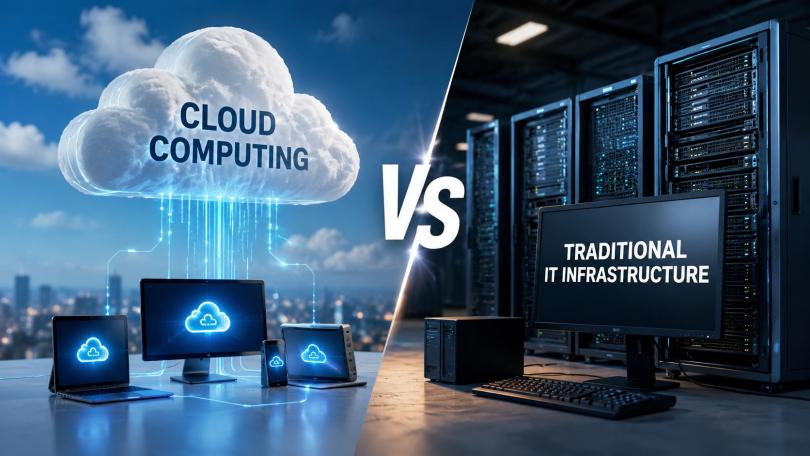

Every business that relies on technology eventually faces the same question: should we run our own servers, or should we let someone else handle the heavy lifting in the cloud? It sounds like a simple decision on the surface, but it touches almost every part of how a company operates, from monthly budgets to how quickly a new product idea can go live.
For decades, traditional IT infrastructure was the only real option. Companies bought servers, built data centers, hired specialists to maintain everything, and hoped their capacity planning was accurate enough to handle growth. Then cloud computing arrived and changed the rules almost overnight. Suddenly, businesses could rent computing power instead of owning it, scale up or down in minutes, and avoid the massive upfront costs that used to come with any serious IT project.
Yet traditional infrastructure hasn’t disappeared. Many organizations, especially those in regulated industries or with very specific performance needs, still rely on on-premises systems, either fully or as part of a hybrid setup. So the debate isn’t really about which model is “better” in some absolute sense. It’s about which model fits a particular business, budget, and set of goals.
In this article, we’ll walk through what cloud computing and traditional IT infrastructure actually mean, how they differ across the factors that matter most, and how to think about choosing between them. By the end, you should have a much clearer picture of where your own organization might fit.
What Is Traditional IT Infrastructure?
Traditional IT infrastructure refers to the physical hardware and systems that a company owns and operates itself. This typically includes on-site servers, storage devices, networking equipment, and often a dedicated data center or server room. Everything from the operating systems to the security patches is managed internally, usually by an in-house IT team.
This model has been the backbone of business technology for a long time. If you’ve ever seen a server room with racks of humming machines and blinking lights, that’s traditional infrastructure in its most literal form. The company that owns those servers is fully responsible for their upkeep, from replacing failing hard drives to upgrading outdated hardware every few years.
Because everything is physically present and controlled by the organization, traditional infrastructure gives businesses a high degree of control. There’s no third party involved in decisions about hardware configuration, network architecture, or physical security. That control comes at a cost, though, both financially and in terms of the effort required to keep systems running smoothly.
Key Components of Traditional Infrastructure
A typical traditional IT setup includes physical servers that host applications and databases, storage systems for backups and data retention, networking hardware like routers and switches, and cooling and power systems to keep everything operational. On top of the hardware, there’s also a software layer, including operating systems, security tools, and the applications themselves, all of which need regular maintenance and updates from the internal team.
What Is Cloud Computing?
Cloud computing flips the traditional model on its head. Instead of owning physical hardware, businesses access computing resources, storage, and applications over the internet, hosted and maintained by a third-party provider. Companies like Amazon Web Services, Microsoft Azure, and Google Cloud have built massive data centers around the world, and businesses essentially rent slices of that infrastructure based on what they need.
The appeal is fairly obvious once you think about it. Instead of spending months planning and purchasing servers, a company can spin up new computing resources in minutes. Need more storage for a busy holiday shopping season? You can scale up instantly and scale back down once demand drops. This flexibility is one of the biggest reasons cloud computing has become the default choice for so many businesses, from small startups to large enterprises.
Cloud computing generally comes in three main forms, and understanding these helps clarify how flexible the model really is.
Types of Cloud Services
Infrastructure as a Service, or IaaS, provides virtualized computing resources like servers and storage over the internet, giving businesses a foundation to build on without owning physical hardware. Platform as a Service, or PaaS, goes a step further by offering a ready-made environment for developing and deploying applications, so teams don’t need to manage the underlying infrastructure at all. Software as a Service, or SaaS, delivers complete applications over the internet, such as email platforms or customer relationship management tools, where the provider handles everything behind the scenes.
Cloud environments can also be public, private, or hybrid. Public clouds share resources across many customers, private clouds are dedicated to a single organization, and hybrid clouds blend the two, often combining cloud resources with some remaining on-premises infrastructure.
Cloud Computing vs Traditional IT Infrastructure: The Core Differences
Now that we’ve covered the basics, let’s get into the real comparison. This is where most businesses start to see which model actually makes sense for their situation.
Cost Structure
One of the most noticeable differences between cloud computing and traditional IT infrastructure is how each one is paid for. Traditional infrastructure requires a significant upfront investment. Companies need to purchase servers, networking equipment, and often construct or lease space to house it all. On top of that initial expense, there are ongoing costs for power, cooling, physical security, and maintenance staff.
Cloud computing, by contrast, typically operates on a pay-as-you-go model. Instead of buying hardware outright, businesses pay for the resources they actually use, whether that’s measured in storage, processing power, or data transfer. This shifts spending from a large capital expense to a more predictable operating expense, which many finance teams find easier to manage. That said, cloud costs can add up quickly if usage isn’t monitored carefully, so it’s not automatically cheaper in every scenario, especially for organizations with steady, predictable workloads that could be handled efficiently with owned hardware.
Scalability and Flexibility
This is an area where cloud computing has a clear advantage. Scaling traditional infrastructure means purchasing new servers, waiting for delivery and installation, and configuring everything before it’s ready to use. That process can take weeks or even months, which is a serious problem if demand spikes unexpectedly.
Cloud computing allows businesses to scale resources up or down almost instantly. If a website suddenly experiences a surge in traffic, cloud infrastructure can automatically allocate more computing power to handle the load, then scale back down once traffic normalizes. This kind of elasticity is incredibly valuable for businesses with fluctuating or unpredictable demand, such as e-commerce platforms during major sales events.
Maintenance and Management
With traditional IT infrastructure, the responsibility for maintenance falls entirely on the internal team. That includes everything from replacing failed hardware to applying security patches and managing software updates. This requires a skilled IT staff and can pull attention away from other strategic projects.
Cloud providers handle most of the underlying maintenance themselves. Businesses using cloud services don’t need to worry about replacing a failing hard drive or updating firmware on a router, because the provider manages that behind the scenes. This frees up internal teams to focus on higher-value work, though it also means giving up a certain amount of direct control over how that maintenance is performed and scheduled.
Security Considerations
Security is often one of the most debated topics in the cloud versus traditional infrastructure conversation. Traditional infrastructure gives companies complete control over their security measures, from physical access to the server room to the specific firewall configurations in place. For industries with strict regulatory requirements, this level of control can be reassuring.
Cloud providers, on the other hand, invest heavily in security, often at a scale that would be difficult for an individual company to match. Major providers employ dedicated security teams, use advanced encryption, and maintain compliance certifications across various industry standards. However, cloud security operates on a shared responsibility model, meaning the provider secures the underlying infrastructure while the business is still responsible for securing its own data, access controls, and configurations. Misconfigurations on the customer’s end remain one of the most common causes of cloud security incidents.
Performance and Reliability
Traditional infrastructure can offer excellent performance when it’s properly sized and maintained, particularly for applications that require low latency and are located physically close to end users. However, performance is limited by the capacity of the hardware on hand, and any unexpected surge in demand can lead to slowdowns or outages if the systems aren’t built to handle it.
Cloud infrastructure benefits from the massive scale of global data centers, which often include redundancy across multiple locations. This means that if one server or even an entire data center experiences an issue, traffic can be rerouted to keep services running. Most major cloud providers offer service level agreements that guarantee high levels of uptime, which can be difficult for a smaller in-house team to match without significant investment.
Accessibility and Remote Work
Cloud computing has played a major role in enabling remote and hybrid work arrangements. Because cloud resources are accessed over the internet, employees can log in and work from virtually anywhere with a stable connection. This has become especially important as more companies embrace flexible work policies.
Traditional infrastructure, particularly when it’s not paired with remote access solutions, can make working outside the office more complicated. Employees may need to use virtual private networks or other tools to securely connect to on-premises systems, which can introduce additional complexity and potential points of failure.
Advantages and Disadvantages at a Glance
To make the comparison a bit easier to digest, here are the two lists we’ll use in this article, summarizing the core trade-offs of each model.
Advantages of cloud computing include lower upfront costs, rapid scalability, reduced maintenance burden, strong built-in redundancy, and easier support for remote work. Disadvantages include ongoing subscription costs that can grow unpredictably, less direct control over infrastructure, potential dependency on internet connectivity, and shared responsibility for security.
Advantages of traditional IT infrastructure include full control over hardware and data, potentially lower long-term costs for stable and predictable workloads, and no dependency on third-party providers for uptime. Disadvantages include high upfront capital investment, slower scalability, greater maintenance responsibility, and the need for a larger in-house technical team.
Hybrid Infrastructure: The Middle Ground
Not every business has to choose one model exclusively. Hybrid infrastructure combines elements of both cloud computing and traditional on-premises systems, allowing organizations to keep sensitive data or critical applications in-house while taking advantage of the cloud’s scalability for other workloads.
This approach has become increasingly popular among mid-sized and large enterprises. A healthcare organization, for example, might keep patient records on secure, on-premises servers to meet strict regulatory requirements, while using cloud resources to handle less sensitive tasks like website hosting or data analytics. This kind of flexibility allows businesses to get the best of both worlds without fully committing to either extreme.
Hybrid setups do introduce their own complexity, though. Managing two different environments requires careful planning around data synchronization, security consistency, and network connectivity between the on-premises and cloud components. It’s not necessarily easier than choosing one model outright, but for many businesses, it offers the right balance between control and flexibility.
Which Option Is Right for Your Business?
There’s no universal answer to whether cloud computing or traditional IT infrastructure is the better choice. It really depends on the specific needs, size, and goals of the organization in question.
Startups and small businesses often benefit from cloud computing because it eliminates the need for large upfront investments and allows them to scale as they grow. Without an established IT department, relying on a cloud provider’s expertise can also reduce the burden of managing complex systems internally.
Larger enterprises with predictable workloads, strict regulatory requirements, or significant existing investments in physical infrastructure may find that traditional systems, or a hybrid approach, make more sense. In some cases, the cost of migrating everything to the cloud simply doesn’t outweigh the benefits, especially if the current infrastructure is already performing well.
Industries with heavy compliance requirements, such as finance, healthcare, and government, often lean toward more control over their data, which can make on-premises or private cloud solutions more appealing. Meanwhile, industries that prioritize speed and innovation, such as technology startups or e-commerce companies, tend to favor the flexibility that cloud computing provides.
Ultimately, the decision should be based on a realistic assessment of budget, technical expertise, growth expectations, and regulatory obligations. It’s worth taking the time to map out both short-term needs and long-term goals before committing to either path, since switching infrastructure models later can be a costly and time-consuming process.
The Future of IT Infrastructure
Looking ahead, it seems clear that cloud computing will continue to grow in adoption, driven by advances in artificial intelligence, big data, and the increasing need for remote accessibility. However, traditional infrastructure isn’t going away entirely. Certain use cases, particularly those involving extremely sensitive data or specialized hardware requirements, will likely continue to rely on on-premises systems for the foreseeable future.
What we’re more likely to see is continued growth in hybrid and multi-cloud strategies, where businesses mix and match different infrastructure models based on the specific needs of each workload. This approach allows organizations to remain flexible as technology, regulations, and business needs continue to evolve.
Frequently Asked Question
Is cloud computing always cheaper than traditional IT infrastructure?
Not always. Cloud computing reduces upfront costs, but ongoing usage fees can add up over time, especially for large, stable workloads that might be cheaper to run on owned hardware.
Can a business switch from traditional infrastructure to the cloud?
Yes, this is called cloud migration. It requires careful planning around data transfer, application compatibility, and downtime management to avoid disruptions.
Is cloud computing less secure than traditional infrastructure?
Not necessarily. Cloud providers often have stronger security resources than individual companies, but businesses still need to manage their own access controls and configurations properly.
What is a hybrid cloud model?
A hybrid model combines cloud computing with traditional on-premises infrastructure, allowing businesses to keep certain data or applications in-house while using the cloud for other needs.
Do small businesses need cloud computing?
Not necessarily, but many small businesses benefit from the lower upfront costs and scalability that cloud services offer, especially when they lack a dedicated IT team.
How does cloud computing support remote work?
Since cloud resources are accessed over the internet, employees can log in and work from any location with a stable connection, making it easier to support remote and hybrid teams.
Which industries still rely heavily on traditional IT infrastructure?
Industries with strict regulatory requirements, such as finance, healthcare, and government, often maintain traditional or private infrastructure to keep tighter control over sensitive data.
Conclusion
Choosing between cloud computing and traditional IT infrastructure isn’t about picking a trend or following what everyone else is doing. It’s about understanding your organization’s specific needs, budget, and long-term goals, then matching those needs to the model that fits best.