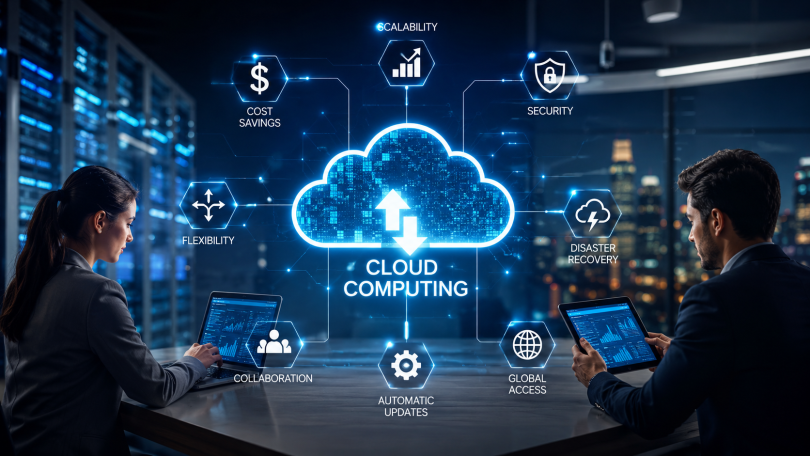

Walk into almost any modern office today, and you’ll notice something interesting: fewer servers humming in the corner, fewer IT staff running around fixing hardware, and a lot more work happening through browsers and apps that live somewhere far away in a data center. That “somewhere far away” is the cloud, and it has quietly rewritten the rules of how businesses operate.
Cloud computing is no longer a buzzword reserved for tech giants. It has become the backbone of how companies of every size store data, run applications, collaborate with teams, and serve their customers. Whether you’re running a five-person startup out of a shared workspace or managing a sprawling enterprise with offices across continents, the benefits of cloud computing touch nearly every part of your business.
In this article, we’ll walk through why cloud computing has become such a game-changer, how it helps small businesses compete with much larger players, and why enterprises are doubling down on cloud infrastructure to stay agile and secure. By the end, you’ll have a clear picture of whether it’s time for your business to move further into the cloud, or perhaps embrace it for the very first time.
What Exactly Is Cloud Computing?
Before diving into the benefits, it helps to get on the same page about what cloud computing actually means. In simple terms, cloud computing is the delivery of computing services, including storage, servers, databases, networking, software, and analytics, over the internet rather than through physical hardware sitting in your office.
Instead of buying a server and maintaining it yourself, you rent computing power and storage from a provider like Amazon Web Services, Microsoft Azure, or Google Cloud. You pay for what you use, access it from anywhere with an internet connection, and let the provider handle the maintenance, security patches, and infrastructure upgrades.
This shift from owning hardware to renting services has fundamentally changed how businesses think about technology. It’s the difference between buying a car outright and using a ride-sharing app whenever you need to get somewhere. Both get you to your destination, but one requires far less upfront investment and ongoing responsibility.
Why Cloud Computing Matters for Small Businesses
Small businesses often operate with tight budgets, limited staff, and big ambitions. That combination makes cloud computing particularly appealing, because it levels the playing field in ways that simply weren’t possible a decade or two ago.
Lower Upfront Costs
Traditionally, starting a business with any serious technology needs meant buying servers, networking equipment, and software licenses before you’d even made your first sale. That capital expense could easily run into tens of thousands of dollars. Cloud computing flips this model on its head by turning a large upfront investment into a manageable monthly subscription.
A small business can now access enterprise-grade infrastructure for a fraction of what it used to cost, paying only for the storage, processing power, or software tools they actually use. This frees up cash flow for other priorities like marketing, hiring, or product development.
Access to Enterprise-Level Tools
One of the most underrated benefits of cloud computing for small businesses is that it grants access to the same powerful tools that large corporations use. A small accounting firm can use the same customer relationship management software as a Fortune 500 company. A boutique marketing agency can run analytics dashboards that were once exclusive to companies with massive IT budgets.
This democratization of technology means small businesses no longer need to settle for watered-down versions of the tools their larger competitors use. They can compete on quality and service rather than being held back by outdated or limited technology.
Flexibility to Work From Anywhere
Cloud computing has also transformed how small teams collaborate. Files, documents, and applications hosted in the cloud can be accessed from a laptop at home, a tablet at a coffee shop, or a phone during a client visit. This flexibility has become especially valuable as remote and hybrid work arrangements have become the norm rather than the exception.
For a small business owner juggling multiple roles, this kind of accessibility means fewer bottlenecks. Work doesn’t grind to a halt just because someone is traveling or working from a different location.
Why Enterprises Are Investing Heavily in Cloud Infrastructure
While small businesses benefit from affordability and accessibility, enterprises are drawn to cloud computing for a different set of reasons, though there is plenty of overlap. Larger organizations deal with massive amounts of data, complex operations, and the constant pressure to innovate faster than their competitors.
Scalability Without the Headaches
Enterprises often experience fluctuating demand. Think of a retail company during the holiday season or a media company covering a major live event. Traditional infrastructure would require these businesses to buy enough server capacity to handle peak demand, even though that capacity sits idle most of the year.
Cloud computing solves this problem elegantly. Enterprises can scale their computing resources up or down based on real-time demand, paying only for what they need at any given moment. This kind of elasticity would be nearly impossible to replicate with physical, on-premises infrastructure.
Global Reach and Consistency
Large organizations frequently operate across multiple countries and time zones. Cloud providers maintain data centers around the world, which means enterprises can deploy applications closer to their customers, reducing latency and improving user experience regardless of geographic location.
This global infrastructure also helps enterprises maintain consistency. A team in Tokyo and a team in London can work from the same centralized systems, access the same real-time data, and collaborate as if they were in the same building.
Advanced Security and Compliance
It might seem counterintuitive, but many enterprises find that cloud providers offer stronger security than what they could build and maintain in-house. Major cloud platforms invest billions of dollars annually in security infrastructure, threat detection, and compliance certifications that would be extraordinarily expensive for any single company to replicate on its own.
For industries with strict regulatory requirements, such as healthcare, finance, and government contracting, cloud providers often maintain compliance certifications that make it easier for enterprises to meet legal and industry standards without building that expertise internally.
Core Benefits of Cloud Computing That Apply to Every Business
While small businesses and enterprises have their own specific motivations, several benefits of cloud computing apply universally, regardless of company size or industry.
Cost Efficiency
Whether you’re a startup founder watching every dollar or a CFO managing a multi-million dollar budget, cost efficiency matters. Cloud computing eliminates many of the hidden costs associated with traditional IT infrastructure, including hardware maintenance, cooling systems, physical security, and the staff needed to manage it all.
Instead of a large capital expenditure, cloud computing shifts spending to an operational expense model. This predictability makes budgeting easier and allows businesses to redirect savings toward growth initiatives rather than infrastructure upkeep.
Improved Collaboration
Cloud-based tools have fundamentally changed how teams work together. Document editing, project management, video conferencing, and file sharing all happen in real time, with multiple people able to contribute simultaneously from different locations. This kind of seamless collaboration was difficult, if not impossible, with older, on-premises systems that required file transfers, version control headaches, and physical presence.
Disaster Recovery and Business Continuity
Natural disasters, hardware failures, cyberattacks, and even simple human error can bring business operations to a halt. Cloud computing dramatically improves disaster recovery capabilities by storing data across multiple redundant locations. If one server or data center goes down, another can take over almost instantly, minimizing downtime and data loss.
For a business of any size, the ability to recover quickly from an unexpected disruption can be the difference between a minor inconvenience and a company-ending catastrophe.
Automatic Updates and Maintenance
With traditional software, businesses often had to manually install updates, patches, and new versions, sometimes causing compatibility issues or requiring costly IT support. Cloud-based systems typically handle these updates automatically, in the background, without disrupting daily operations. This means businesses always have access to the latest features and security patches without lifting a finger.
Environmental Benefits
Cloud computing also tends to be more environmentally friendly than maintaining individual, on-premises data centers. Because cloud providers operate at massive scale, they can optimize energy usage, cooling systems, and hardware efficiency in ways that individual businesses simply cannot match. For companies increasingly focused on sustainability goals, this is a meaningful side benefit of moving to the cloud.
Common Types of Cloud Computing Services
Understanding the different types of cloud services can help businesses choose the right approach for their needs. Broadly speaking, cloud computing is delivered through three main models: Infrastructure as a Service, Platform as a Service, and Software as a Service.
Infrastructure as a Service provides the basic building blocks of computing, such as virtual servers and storage, giving businesses the flexibility to build and manage their own applications on top of that infrastructure. Platform as a Service takes this a step further by providing a ready-made environment for developers to build and deploy applications without worrying about the underlying infrastructure. Software as a Service is the most familiar model for everyday users, delivering complete applications like email, accounting software, or customer relationship management tools directly through a web browser.
Most businesses end up using a combination of these models depending on their specific needs, whether that’s hosting a website, running complex data analytics, or simply using cloud-based productivity software.
Addressing Common Concerns About Cloud Computing
No conversation about cloud computing would be complete without acknowledging the concerns businesses often have before making the switch. Data security remains a top worry, particularly for companies handling sensitive customer information. However, reputable cloud providers typically offer security measures, including encryption, multi-factor authentication, and continuous monitoring, that exceed what most individual businesses could implement on their own.
Another common concern is vendor lock-in, where a business becomes so dependent on a particular cloud provider that switching becomes difficult or costly. This is a legitimate consideration, and businesses should carefully evaluate contracts, data portability options, and exit strategies before committing to a specific provider.
Internet dependency is another factor worth considering. Since cloud computing relies on internet connectivity, businesses in areas with unreliable internet access may face challenges. However, as broadband infrastructure continues to improve globally, this concern becomes less significant with each passing year.
How to Choose the Right Cloud Solution for Your Business
Selecting the right cloud computing approach depends on several factors, including your business size, industry, budget, and specific operational needs. Small businesses often benefit most from Software as a Service solutions, which require minimal technical expertise and offer quick implementation. These tools handle everything from accounting to customer management without requiring an in-house IT team.
Enterprises, on the other hand, often require more customized solutions, sometimes combining multiple cloud models or even adopting a hybrid approach that blends cloud infrastructure with existing on-premises systems. This hybrid model allows larger organizations to gradually transition to the cloud while maintaining certain legacy systems that may be too complex or costly to migrate immediately.
Regardless of business size, it’s worth taking time to evaluate providers based on reliability, customer support, security certifications, and pricing structures before making a final decision. A rushed migration without proper planning can lead to disruptions, so working with experienced IT consultants or cloud specialists during the transition often pays off in the long run.
The Future of Cloud Computing in Business
Looking ahead, cloud computing shows no signs of slowing down. Emerging technologies like artificial intelligence, machine learning, and the Internet of Things are increasingly built on cloud infrastructure, making cloud adoption almost a prerequisite for businesses wanting to stay competitive in an increasingly digital economy.
Edge computing, which processes data closer to where it’s generated rather than sending everything back to a central server, is also gaining traction as a complement to traditional cloud computing. This hybrid approach promises even faster processing times for applications that require real-time responsiveness, such as autonomous vehicles or industrial automation.
As these technologies continue to mature, businesses that have already embraced cloud computing will find themselves better positioned to adopt new innovations quickly, while those still relying on outdated infrastructure may find themselves playing catch-up.
Frequently Asked Question
Is cloud computing safe for storing sensitive business data?
Yes, reputable cloud providers invest heavily in security measures like encryption and continuous monitoring, often exceeding what individual businesses can achieve on their own.
How much does cloud computing typically cost for a small business?
Costs vary widely based on usage, but most providers offer pay-as-you-go pricing, allowing small businesses to start with minimal investment and scale as needed.
Can enterprises use cloud computing alongside existing on-premises systems?
Absolutely. Many enterprises adopt a hybrid model, combining cloud infrastructure with legacy systems during a gradual transition period.
What happens if my internet connection goes down?
Cloud access requires internet connectivity, so temporary outages can limit access. However, many providers offer offline functionality for certain applications.
Is switching to the cloud a complicated process?
Migration complexity depends on the size and nature of your existing systems, but working with experienced cloud consultants can significantly simplify the process.
Do small businesses really need cloud computing?
While not mandatory, cloud computing offers small businesses cost savings, flexibility, and access to enterprise-grade tools that can significantly improve competitiveness.
What is the difference between public, private, and hybrid cloud?
Public cloud shares infrastructure across multiple businesses, private cloud is dedicated to a single organization, and hybrid cloud combines both approaches for greater flexibility.
Conclusion
Cloud computing has moved far beyond being a passing trend. It has become a fundamental part of how businesses, whether small startups or sprawling enterprises, operate, compete, and grow in today’s digital landscape. From reducing costs and improving collaboration to enhancing security and enabling rapid scalability, the benefits of cloud computing touch nearly every aspect of modern business operations.