
Businesses today operate in an environment that can change quickly. Customer expectations, market conditions, technology, competition, and economic trends can shift within a short period. Companies that depend on slow and complicated processes may struggle to respond, while businesses with flexible digital systems can often adjust more quickly.
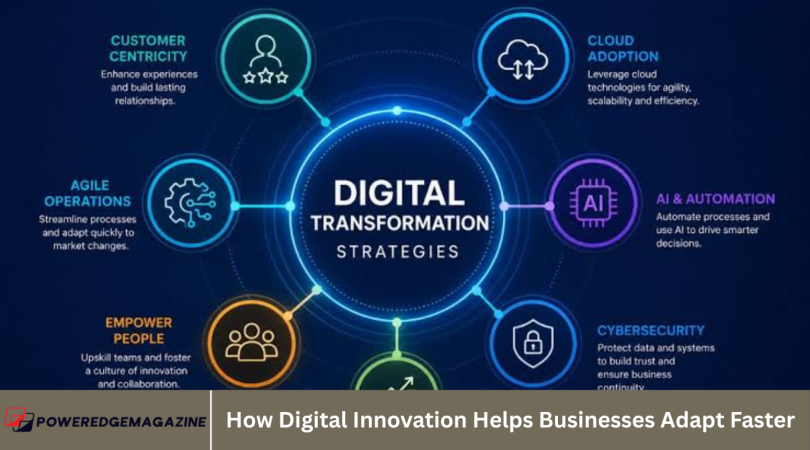
Digital innovation gives companies tools to improve operations, understand customers, automate repetitive work, and make faster decisions. Artificial intelligence, cloud computing, automation, data analytics, digital communication, and online platforms are helping businesses become more flexible. By using these technologies strategically, companies can respond to challenges and take advantage of new opportunities.
Understanding Digital Innovation
Digital innovation involves using technology to create better products, services, processes, or business models.
It is not simply about purchasing new software or devices. The real value comes from using technology to solve business problems and improve the way an organization works.
A company may use digital innovation to automate tasks, improve customer service, analyze data, or launch a new digital service.
Why Business Agility Matters
Business agility means being able to respond effectively to change.
A company may need to adjust its products because customer preferences have changed. It may need to update its marketing strategy because a new competitor has entered the market.
Businesses can also face supply chain problems, economic uncertainty, technological changes, and unexpected disruptions.
Digital tools can help organizations respond to these situations more efficiently.
Faster Decision-Making
Data is one of the most valuable resources for modern businesses.
Digital systems can collect and analyze information quickly.
Managers can use dashboards, analytics platforms, and AI-powered tools to understand sales, customer behavior, inventory, and other important areas.
Faster access to information can help leaders make better decisions.
Artificial Intelligence
Artificial intelligence is helping businesses become more responsive.
AI can analyze large amounts of information, identify patterns, generate insights, and support decision-making.
Companies can use AI to forecast demand, understand customers, detect risks, and improve operations.
As AI becomes more accessible, businesses of different sizes can use it to respond to changing conditions.
AI-Powered Forecasting
Predicting future demand can be difficult.
AI can analyze historical sales, customer behavior, market information, and other factors to estimate future trends.
Businesses can use these forecasts to plan inventory, staffing, marketing, and production.
Better forecasting can help companies respond to demand changes before they become major problems.
Automation
Automation allows businesses to complete routine tasks with less manual effort.
Companies can automate data entry, scheduling, notifications, reporting, customer communication, and administrative workflows.
This saves employees time and allows them to focus on tasks that require human judgment.
Intelligent Automation
Traditional automation follows predefined rules.
Intelligent automation combines automation with technologies such as AI and machine learning.
This allows systems to handle more complex workflows and respond to changing information.
Intelligent automation can help businesses become more flexible.
Cloud Computing
Cloud computing provides businesses with flexible digital infrastructure.
Companies can use cloud services for storage, software, databases, communication, and computing power.
Cloud systems can be scaled as business requirements change.
This makes it easier for companies to respond to growth or temporary increases in demand.
Remote Work
Digital technology allows businesses to operate with employees in different locations.
Cloud applications, video conferencing, messaging platforms, and project management systems support remote and hybrid teams.
This flexibility can help companies continue operating during disruptions.
It can also allow businesses to recruit talent from a wider geographic area.
Digital Collaboration
Employees need effective communication when businesses are changing quickly.
Digital collaboration platforms allow teams to share information, manage projects, communicate, and coordinate tasks.
Better collaboration can reduce delays and help teams respond faster.
Data Analytics
Data analytics helps businesses understand what is happening inside and outside the organization.
Companies can analyze sales, website activity, customer feedback, marketing performance, and operational information.
These insights can reveal problems and opportunities.
Businesses can then adjust their strategies based on evidence rather than assumptions.
Real-Time Information
Traditional reports may take hours or days to prepare.
Modern digital systems can provide information much faster.
Real-time dashboards can show changes in sales, inventory, customer activity, and other business metrics.
This allows managers to respond quickly when conditions change.
Customer Expectations
Customer expectations are constantly evolving.
People want fast communication, convenient purchasing, personalized services, and easy access to information.
Digital innovation allows businesses to adjust their customer experience more quickly.
Personalized Customer Experiences
Businesses can use customer data to create more relevant experiences.
AI and analytics can identify customer preferences and support personalized recommendations, offers, and communication.
Personalization can help businesses remain competitive when customers have many alternatives.
Digital Customer Support
Customer service can become more flexible through digital technology.
Chatbots, automated messaging, knowledge bases, and customer service platforms can provide quick assistance.
Employees can then focus on complex customer problems.
This combination can improve response times.
E-Commerce
E-commerce gives businesses flexibility in reaching customers.
Companies can sell products online without depending entirely on physical stores.
Online platforms also allow businesses to quickly update products, prices, promotions, and customer information.
This can make it easier to respond to market changes.
Digital Payments
Digital payment systems make transactions faster and more convenient.
Businesses can accept payments through online banking, cards, mobile wallets, and other electronic systems.
Flexible payment options can improve customer convenience and support online commerce.
Digital Marketing
Digital marketing allows businesses to change campaigns quickly.
Companies can adjust advertisements, social media content, email campaigns, and online promotions based on performance.
Unlike many traditional marketing methods, digital campaigns can provide data almost immediately.
Social Media
Social media provides direct communication between businesses and customers.
Companies can monitor customer opinions, respond to questions, announce changes, and promote new products.
Social media can also help businesses identify emerging trends.
Supply Chain Management
Supply chains can be affected by changing demand, transportation problems, shortages, and other disruptions.
Digital supply chain systems provide greater visibility into inventory and shipments.
AI can also help companies forecast demand and identify potential problems.
Inventory Management
Accurate inventory information is important for adapting to customer demand.
Digital inventory systems can track stock levels and automatically update information when products are purchased or received.
Businesses can use this information to make faster purchasing and production decisions.
Digital Product Development
Technology can help businesses develop products more quickly.
Companies can create digital prototypes, test features, collect customer feedback, and make changes without completely rebuilding a product.
This supports faster experimentation.
Minimum Viable Products
Businesses can launch simplified versions of digital products to test market interest.
Customer feedback can then guide future improvements.
This approach reduces the risk of spending large amounts of money on a product before understanding what customers actually want.
Flexible Business Models
Digital technology allows companies to introduce new ways of generating revenue.
Subscription services, online marketplaces, digital products, and on-demand services can provide additional options.
Businesses can experiment with different models and respond to changing customer preferences.
Cybersecurity
Adaptability must be supported by security.
Businesses rely heavily on digital systems, making cybersecurity an important part of digital innovation.
Companies need to protect customer information, financial data, intellectual property, and internal systems.
Strong security allows businesses to innovate without creating unnecessary risks.
Data Privacy
Businesses often collect large amounts of customer information.
Privacy should be considered when developing digital systems.
Companies need clear policies for collecting, storing, and using data.
Responsible data management can help maintain customer trust.
Employee Training
Technology changes quickly, so employees need opportunities to learn new skills.
Training can help workers understand AI, automation, data tools, cybersecurity, and digital platforms.
Skilled employees can help companies adapt technology more effectively.
Digital Skills
Businesses need workers who can combine technical knowledge with problem-solving abilities.
Data analysis, communication, creativity, critical thinking, and technology literacy are increasingly valuable.
Continuous learning can help employees keep up with changing digital tools.
Improving Operational Efficiency
Digital innovation can help businesses identify inefficient processes.
Automation and analytics can show where time and resources are being wasted.
Companies can then redesign workflows to improve efficiency.
Reducing Costs
Technology can reduce certain operating costs.
Automation can lower the amount of time employees spend on repetitive tasks.
Cloud services can provide flexible infrastructure.
Digital communication can also reduce some traditional business expenses.
Supporting Business Continuity
Unexpected disruptions can affect physical operations.
Digital systems can help businesses continue serving customers and coordinating employees during difficult periods.
Cloud services, remote collaboration, online sales, and digital communication can provide greater operational flexibility.
Competing in Changing Markets
Markets can become competitive very quickly.
New businesses can use technology to enter established industries.
Digital innovation allows existing companies to improve their services and respond to competitors.
A company that adapts quickly may be better positioned to protect its market share.
Supporting Small Businesses
Digital innovation is not only useful for large corporations.
Small businesses can use affordable cloud software, digital marketing, online payment systems, e-commerce platforms, and AI tools.
These technologies can help smaller companies compete with businesses that have larger resources.
The Role of Leadership
Successful digital transformation requires strong leadership.
Business leaders need to understand the company’s goals and identify where technology can provide meaningful value.
They should encourage experimentation while managing security, privacy, and financial risks.
Creating an Innovation Culture
Technology alone cannot make a business adaptable.
Employees should be encouraged to suggest improvements and test new ideas.
A culture that supports learning and experimentation can help businesses respond to change more effectively.
Measuring Digital Transformation
Companies should measure the results of digital innovation.
Useful measurements can include productivity, customer satisfaction, sales, operating costs, response times, conversion rates, and employee efficiency.
Tracking performance helps businesses determine whether their digital strategies are working.
Challenges of Digital Innovation
Digital transformation can create challenges.
Businesses may face implementation costs, employee resistance, technical difficulties, cybersecurity risks, and integration problems.
Companies should therefore introduce new technology carefully.
Avoiding Technology Overload
Using too many digital tools can create confusion.
Businesses should focus on technologies that solve real problems.
A simple system that employees understand may be more valuable than a complicated platform with features the company rarely uses.
The Importance of Scalability
Businesses should choose technologies that can grow with them.
Scalable digital systems can support increased customers, employees, transactions, and data.
This reduces the need to replace systems every time the company expands.
The Future of Business Adaptability
Future businesses will likely rely more heavily on AI, automation, connected devices, advanced analytics, and cloud technology.
AI agents may handle increasingly complex workflows.
Businesses may also use real-time data to make faster decisions.
These developments could make organizations more responsive to changing markets.
Digital Innovation as a Long-Term Strategy
Digital innovation should not be treated as a one-time project.
Technology continues to evolve, and customer expectations continue to change.
Companies need to review their systems regularly and look for ways to improve.
Continuous innovation can help organizations remain adaptable.
Frequently Asked Questions
How does digital innovation help businesses adapt faster?
Digital innovation helps businesses access information quickly, automate tasks, improve customer experiences, adjust operations, and respond to market changes more efficiently.
What role does AI play in business adaptability?
AI can analyze data, forecast trends, identify patterns, personalize customer experiences, and support faster decision-making.
Can small businesses use digital innovation?
Yes. Small businesses can use cloud services, AI tools, digital marketing, e-commerce platforms, online payment systems, and automation to improve efficiency and compete more effectively.
Does digital innovation reduce business costs?
It can reduce certain costs by automating repetitive work, improving operational efficiency, reducing infrastructure requirements, and helping businesses make better resource decisions.
What is the future of business adaptability?
Businesses are likely to become more dependent on AI, automation, cloud computing, real-time analytics, and connected technologies to respond quickly to changing customer needs and market conditions.
Conclusion
Digital innovation helps businesses adapt faster by improving decision-making, automating repetitive tasks, supporting flexible operations, and making customer interactions more responsive. Technologies such as artificial intelligence, cloud computing, data analytics, automation, e-commerce, and digital communication give companies the tools they need to respond to changing markets and customer expectations.
However, successful adaptation requires more than technology. Businesses also need skilled employees, strong leadership, cybersecurity, responsible data practices, and a culture that encourages innovation. Companies that continuously evaluate their needs and adopt practical digital solutions can become more flexible, efficient, and prepared for future changes.