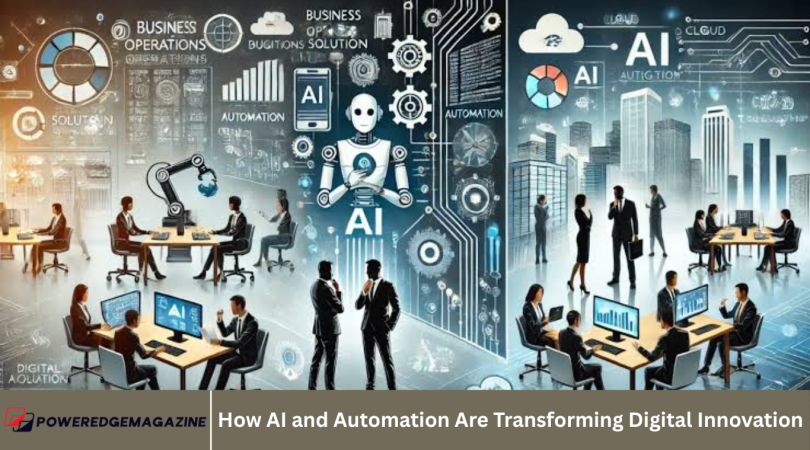

Artificial intelligence and automation are changing the way businesses use technology. Companies are adopting these tools to improve productivity, reduce repetitive work, understand data, serve customers, and develop new digital products. What was once considered advanced technology is now becoming part of everyday business operations.
The combination of AI and automation is especially powerful because it allows digital systems to do more than simply store or process information. Modern systems can analyze patterns, generate content, make recommendations, communicate with users, and complete certain tasks with limited human involvement. As these technologies continue to develop, they are likely to become an even bigger part of digital innovation.
What Is Digital Innovation?
Digital innovation means using digital technology to create new products, services, processes, or ways of doing business.
It can include cloud computing, mobile applications, data analytics, artificial intelligence, automation, connected devices, digital platforms, and other technologies.
The main goal is not simply to use new technology. It is to use technology to solve problems, improve experiences, increase efficiency, and create new opportunities.
The Rise of Artificial Intelligence
Artificial intelligence has become one of the most important technologies in digital innovation.
AI systems can analyze information, identify patterns, understand language, recognize images, generate content, and support decision-making.
Businesses are using AI across areas such as customer service, marketing, finance, healthcare, software development, manufacturing, and research.
The growing availability of AI tools has also made advanced technology more accessible to smaller businesses.
What Is Automation?
Automation involves using technology to perform tasks with limited human intervention.
Traditional automation follows predefined instructions, while newer intelligent automation can use AI and data to handle more complex situations.
Businesses can automate repetitive activities such as data entry, scheduling, document processing, notifications, inventory updates, and customer communications.
AI and Automation Working Together
AI and automation become more powerful when they work together.
AI can analyze information and make predictions or recommendations, while automation can use those results to perform actions.
For example, an AI system might identify a customer request, determine what information is needed, and then trigger an automated response.
This combination can make digital systems more responsive and efficient.
Improving Business Productivity
One of the biggest benefits of AI and automation is improved productivity.
Employees often spend significant amounts of time handling repetitive administrative tasks.
Automation can take over many of these activities.
AI can also assist employees with research, writing, analysis, organization, and decision support.
This allows workers to spend more time on tasks that require creativity and human judgment.
Reducing Repetitive Work
Repetitive tasks can consume valuable employee time.
Businesses can automate processes such as invoice management, appointment scheduling, email notifications, data organization, and report generation.
Reducing repetitive work can improve efficiency while allowing employees to focus on more meaningful responsibilities.
Improving Decision-Making
Businesses generate large amounts of information every day.
AI can analyze this information faster than traditional manual methods.
Companies can use AI-powered analytics to identify trends, forecast demand, detect unusual activity, and support strategic decisions.
Human leaders can then use these insights alongside their own experience and judgment.
Predictive Analytics
Predictive analytics is an important application of AI.
Businesses can analyze historical information to estimate future outcomes.
For example, retailers can forecast product demand, manufacturers can predict equipment problems, and financial organizations can identify potential risks.
Predictive systems can help companies prepare rather than simply react.
Generative AI
Generative AI has introduced a new level of digital innovation.
These systems can create text, images, software code, audio, video, and other forms of digital content.
Companies can use generative AI for marketing, customer communication, research, software development, documentation, and creative work.
Human review remains important because AI-generated content can contain errors.
AI-Powered Customer Service
Customer service is one of the areas being transformed by AI.
AI chatbots can answer common questions, provide product information, help customers navigate services, and support basic troubleshooting.
Automated systems can operate around the clock.
When a problem requires human attention, the system can transfer the conversation to a customer service representative.
Personalized Customer Experiences
AI can help businesses understand individual customer preferences.
Companies can analyze browsing behavior, purchase history, interactions, and other information to create personalized recommendations.
Online stores can suggest relevant products, while digital platforms can customize content.
Personalization can improve customer engagement when data is handled responsibly.
Faster Responses
Automation allows businesses to respond to customers quickly.
Automated emails, order confirmations, shipping updates, appointment reminders, and notifications can be delivered without manual intervention.
AI can also help customer service teams identify and prioritize requests.
Faster responses can improve the overall customer experience.
AI in Digital Marketing
Digital marketing is another area experiencing major changes.
AI can analyze audience behavior, identify trends, assist with content creation, and help businesses optimize campaigns.
Automation can schedule marketing messages, manage customer journeys, and organize campaign activities.
These tools allow marketing teams to work more efficiently.
Content Creation
AI tools can assist with many forms of content creation.
Businesses can use them to generate ideas, create initial drafts, summarize information, and adapt content for different platforms.
However, human creativity and editorial review remain important for quality, originality, accuracy, and brand consistency.
Software Development
AI is also influencing software development.
AI-powered coding tools can help developers write code, identify errors, explain technical concepts, and create documentation.
Automation can support testing, deployment, monitoring, and other development processes.
These technologies can speed up software development while keeping developers involved in important decisions.
AI in Cybersecurity
Cybersecurity teams are using AI to identify suspicious patterns and unusual activity.
AI systems can process large amounts of security data and help detect potential threats.
Automation can then trigger certain security responses.
However, cybersecurity still requires human expertise because attackers continuously develop new methods.
AI in Manufacturing
Manufacturing is increasingly using AI and automation to improve production.
Robotic systems can perform repetitive physical tasks, while AI can analyze production data.
Sensors can monitor equipment and identify possible problems.
These technologies can improve efficiency, consistency, and quality.
Predictive Maintenance
Machines can experience unexpected failures that interrupt production.
AI-powered predictive maintenance systems analyze sensor information to identify signs of possible equipment problems.
Companies can schedule maintenance before a major failure occurs.
This can reduce downtime and potentially lower maintenance costs.
Intelligent Supply Chains
AI and automation can improve supply chain management.
Businesses can use AI to forecast demand, optimize inventory, monitor shipments, and identify potential disruptions.
Automated systems can update records and trigger actions when inventory reaches certain levels.
Better supply chain visibility can help businesses respond faster.
AI in Healthcare
Healthcare organizations are exploring AI for research, administration, medical imaging, patient support, and other applications.
Automation can reduce administrative workloads and improve information management.
AI-based systems can assist professionals, but important healthcare decisions require appropriate human oversight.
AI in Finance
Financial organizations use AI and automation for fraud detection, customer support, risk analysis, document processing, and financial forecasting.
Automated systems can process large volumes of transactions quickly.
AI can also identify unusual patterns that may require further investigation.
AI in Education
Education is another area where AI can support digital innovation.
AI tools can help students with learning activities, provide personalized educational content, and assist teachers with administrative tasks.
Automation can also help manage assignments, communications, and routine processes.
Human teachers remain important for guidance, judgment, and personal support.
AI and Remote Work
AI and automation can make remote work more efficient.
Digital assistants can help organize schedules, summarize information, manage tasks, and support communication.
Automation can reduce the need for employees to manually coordinate routine processes.
This can be especially useful for distributed teams.
Cloud-Based AI
Cloud computing has helped make AI more accessible.
Businesses can access computing resources and AI services without building large physical systems themselves.
Cloud platforms can also allow companies to scale their technology according to demand.
This makes advanced digital tools available to a wider range of organizations.
AI and Small Businesses
AI is not limited to large corporations.
Small businesses can use AI for customer service, marketing, content creation, data analysis, scheduling, and other activities.
Affordable digital tools can help smaller companies improve efficiency without building large technology departments.
Creating New Business Models
AI and automation can create completely new business opportunities.
Companies can develop AI-powered services, automated platforms, intelligent applications, and personalized digital experiences.
Technology can also allow traditional businesses to introduce subscription services and other digital revenue models.
Changing the Workforce
AI and automation are likely to change the types of tasks employees perform.
Some repetitive activities may become automated, while demand for technology-related skills may increase.
Workers may need to develop skills in AI, data analysis, cybersecurity, digital communication, and technology management.
Human skills such as creativity, leadership, critical thinking, and communication will also remain valuable.
Human-AI Collaboration
The future of work is not necessarily about humans versus machines.
In many situations, the most effective approach may involve humans and AI working together.
AI can handle information-heavy or repetitive tasks while people provide judgment, creativity, empathy, and strategic thinking.
This combination can create more effective workflows.
Improving Employee Experience
Automation can reduce frustrating repetitive work.
Employees can spend less time entering information or performing routine administrative tasks.
AI assistants can also help workers find information and organize their responsibilities.
A better employee experience can contribute to higher productivity and engagement.
Challenges of AI and Automation
Despite their benefits, AI and automation create important challenges.
Companies may face implementation costs, technical difficulties, employee resistance, cybersecurity risks, privacy concerns, and concerns about inaccurate AI-generated information.
Businesses need careful planning before adopting these technologies.
Data Privacy
AI systems often require large amounts of data.
Businesses must manage customer and employee information responsibly.
Strong privacy policies and appropriate security controls are important for maintaining trust.
Companies should understand what data their AI systems use and how that information is stored and processed.
Accuracy and Reliability
AI systems are not always correct.
They can produce inaccurate information, misunderstand context, or make inappropriate recommendations.
For this reason, businesses should establish review processes for important AI-generated results.
Human oversight is especially important when decisions can have serious consequences.
Cybersecurity Risks
AI can improve cybersecurity, but it can also introduce new risks.
Attackers may use AI to create more sophisticated scams, automate attacks, or manipulate information.
Companies therefore need to update their security strategies as AI technology develops.
Cost of Implementation
Advanced AI and automation systems can require investment in software, infrastructure, integration, training, and security.
Businesses should evaluate the expected benefits before making large investments.
Starting with smaller projects can allow companies to test technology before expanding it.
Employee Training
Employees need to understand how new systems work.
Training can help workers use AI tools effectively and recognize their limitations.
Businesses should also teach employees about data privacy, cybersecurity, and responsible AI use.
The Importance of Human Oversight
AI should not always operate independently.
Human oversight can help identify errors, evaluate recommendations, and make important decisions.
The right balance between automation and human involvement depends on the task and its potential risks.
Measuring AI and Automation Success
Companies should measure the results of their technology investments.
Useful measurements can include productivity, operating costs, customer satisfaction, response times, error rates, revenue, and employee efficiency.
These measurements can help businesses determine whether a digital innovation project is actually creating value.
The Future of AI and Automation
AI and automation are likely to become more integrated into everyday business operations.
AI agents may handle more complex workflows, automation systems may become more adaptive, and businesses may use intelligent technology across multiple departments.
The technologies will likely become more accessible as tools improve.
AI and Digital Transformation
Digital transformation is becoming increasingly connected to AI.
Businesses are no longer simply moving paper processes online.
They are redesigning workflows around intelligent systems, automation, data, and digital platforms.
This can create deeper changes in how organizations operate.
Building an AI-Ready Business
Companies that want to adopt AI successfully need reliable data, clear goals, skilled employees, strong security, and effective leadership.
Businesses should identify specific problems that AI can solve rather than adopting technology simply because it is popular.
A clear strategy can improve the chances of successful implementation.
Responsible Digital Innovation
Responsible innovation should remain a priority.
Businesses need to consider fairness, transparency, privacy, security, and the possible impact of automation on employees.
Technology should be used to create sustainable value rather than simply reduce costs.
Frequently Asked Questions
How are AI and automation transforming digital innovation?
AI provides systems with capabilities such as analysis, prediction, language understanding, and content generation, while automation allows digital systems to perform tasks with less human intervention.
Can AI and automation improve business productivity?
Yes. They can reduce repetitive work, speed up processes, analyze information, improve decision-making, and allow employees to focus on higher-value activities.
Will AI and automation replace human workers?
They may automate certain tasks and change some job responsibilities, but many roles will continue to require human creativity, judgment, communication, empathy, and strategic thinking.
What are the main risks of using AI and automation?
Important risks include inaccurate results, privacy concerns, cybersecurity threats, implementation costs, employee resistance, and inappropriate use of automated systems.
What is the future of AI and automation?
AI and automation are expected to become more integrated into business operations, with intelligent systems handling increasingly complex tasks while humans continue to provide oversight, creativity, and strategic direction.
Conclusion
AI and automation are transforming digital innovation by changing how businesses operate, make decisions, serve customers, and develop new products. AI can analyze information, generate content, identify patterns, and support complex tasks, while automation can turn these capabilities into practical workflows that save time and improve efficiency. Together, they can help businesses increase productivity and create more personalized digital experiences.
However, successful adoption requires careful planning, employee training, strong cybersecurity, responsible data management, and human oversight. As these technologies continue to develop, companies that use them strategically may be better prepared for a faster and more competitive digital economy.