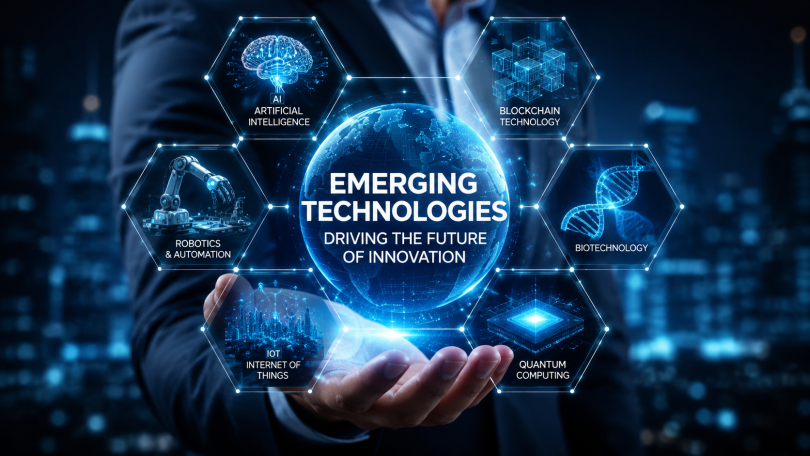

Innovation has always been the driving force behind human progress. From the invention of the wheel to the rise of the internet, groundbreaking technologies have transformed the way people live, work, and interact. Today, the pace of technological advancement is accelerating faster than ever, creating unprecedented opportunities for businesses, governments, and individuals alike.
Emerging technologies are no longer futuristic concepts confined to research laboratories; they are becoming integral parts of everyday life and reshaping industries across the globe. The rapid development of artificial intelligence, blockchain, quantum computing, biotechnology, advanced robotics, and other cutting-edge innovations is fundamentally changing how organizations operate and compete.
These technologies are enhancing efficiency, improving decision-making, creating new business models, and solving complex global challenges. As digital transformation continues to gain momentum, understanding the role of emerging technologies becomes essential for anyone seeking to thrive in the modern economy.
Understanding Emerging Technologies and Their Importance
Emerging technologies refer to innovative tools, systems, and methodologies that are currently developing or gaining widespread adoption. While some of these technologies are still evolving, their potential to disrupt traditional processes and create new possibilities is significant.
The importance of emerging technologies lies in their ability to address complex problems, improve productivity, and unlock new avenues for growth. Businesses that successfully embrace technological innovation often gain a competitive advantage by enhancing customer experiences, streamlining operations, and accelerating product development.
In an increasingly connected world, organizations must remain agile and forward-thinking to capitalize on technological advancements. Those that fail to adapt risk falling behind competitors who leverage innovation to meet changing market demands.
Artificial Intelligence: Revolutionizing Every Industry
Artificial intelligence (AI) stands at the forefront of emerging technologies driving the future of innovation. AI enables machines to simulate human intelligence, perform complex tasks, analyze massive datasets, and make informed decisions with minimal human intervention.
The influence of AI can be seen across numerous sectors. In healthcare, AI-powered systems assist doctors in diagnosing diseases with greater accuracy. In finance, intelligent algorithms detect fraud, assess risks, and optimize investment strategies. Retail businesses use AI to personalize customer experiences, predict purchasing behavior, and improve inventory management.
Machine learning, a subset of AI, allows systems to learn from data and continuously improve performance over time. This capability is transforming industries by enabling predictive analytics, automation, and intelligent decision-making.
As AI technologies continue to evolve, their impact on innovation will expand significantly, creating smarter systems and more efficient business operations worldwide.
Generative AI and Creative Innovation
One of the most exciting developments within artificial intelligence is generative AI. These systems can create text, images, videos, software code, and other forms of content with remarkable accuracy and creativity.
Businesses are increasingly adopting generative AI to automate content creation, enhance customer support, accelerate software development, and streamline marketing campaigns. The technology is empowering professionals to focus on strategic tasks while reducing repetitive workloads.
The growing capabilities of generative AI highlight how emerging technologies are redefining creativity and productivity across multiple industries.
Quantum Computing: Unlocking Unprecedented Processing Power
Quantum computing represents a revolutionary leap in computational capability. Unlike traditional computers that use bits, quantum computers utilize quantum bits, or qubits, enabling them to process vast amounts of information simultaneously.
This breakthrough has the potential to solve problems that would take conventional computers thousands of years to complete. Researchers believe quantum computing could transform industries such as pharmaceuticals, logistics, cybersecurity, financial modeling, and climate science.
For example, pharmaceutical companies may use quantum computing to accelerate drug discovery by simulating molecular interactions at extraordinary speeds. Financial institutions could analyze complex market scenarios more accurately, while logistics companies may optimize global supply chains with greater efficiency.
Although quantum computing remains in its early stages, its long-term potential makes it one of the most significant emerging technologies driving future innovation.
Blockchain Technology Beyond Cryptocurrency
Many people associate blockchain technology primarily with cryptocurrencies. However, its applications extend far beyond digital currencies.
Blockchain is a decentralized digital ledger that records transactions securely and transparently. Its ability to provide trust, transparency, and data integrity makes it valuable across various industries.
Supply chain management is one area where blockchain is creating significant innovation. Organizations can track products from origin to destination, ensuring authenticity and reducing fraud. Healthcare providers can securely store patient records, while governments can improve transparency in public services.
The decentralized nature of blockchain reduces reliance on intermediaries, streamlines processes, and enhances security. As adoption increases, blockchain will continue to play a vital role in shaping innovative business models and digital ecosystems.
Internet of Things: Connecting the Physical and Digital Worlds
The Internet of Things (IoT) refers to a network of interconnected devices that collect, share, and analyze data through the internet. These devices range from smart home appliances and wearable fitness trackers to industrial sensors and connected vehicles.
IoT technology is transforming how organizations monitor operations, manage resources, and deliver services. Businesses can gather real-time insights, improve efficiency, and reduce operational costs through connected systems.
In manufacturing, IoT sensors monitor equipment performance and predict maintenance needs before failures occur. Smart cities use connected infrastructure to optimize traffic flow, manage energy consumption, and enhance public safety.
As billions of devices become interconnected, IoT will continue driving innovation by enabling smarter environments and data-driven decision-making.
Advanced Robotics and Automation
Robotics has evolved significantly over the past decade, becoming more intelligent, adaptable, and capable of performing complex tasks. Advanced robotics is transforming industries by automating repetitive processes, increasing productivity, and improving safety.
Modern robots can work alongside humans in manufacturing facilities, warehouses, and healthcare settings. Collaborative robots, often called cobots, assist workers rather than replace them, enhancing efficiency and reducing physical strain.
Automation technologies powered by AI and machine learning are further accelerating operational improvements. Organizations can automate routine tasks, reduce errors, and allocate human resources to higher-value activities.
As robotics technology becomes more sophisticated and affordable, its role in driving innovation will continue to expand across diverse sectors.
Biotechnology and Genetic Engineering
Biotechnology is revolutionizing healthcare, agriculture, and environmental sustainability. Advances in genetic engineering and molecular biology are enabling scientists to develop innovative solutions for some of humanity’s most pressing challenges.
Gene-editing technologies have opened new possibilities for treating genetic disorders, improving crop yields, and developing disease-resistant plants. Researchers are exploring ways to create personalized medical treatments tailored to an individual’s genetic profile.
Biotechnology is also contributing to sustainable practices by supporting the development of alternative proteins, biodegradable materials, and environmentally friendly manufacturing processes.
The convergence of biology and technology is creating remarkable opportunities for innovation that could significantly improve quality of life around the world.
Augmented Reality and Virtual Reality
Augmented reality (AR) and virtual reality (VR) are transforming how people interact with digital information. These immersive technologies create engaging experiences that blend physical and virtual environments.
Businesses are utilizing AR and VR for employee training, product visualization, customer engagement, and remote collaboration. In education, immersive learning experiences help students better understand complex concepts. Healthcare professionals use VR simulations for surgical training and patient therapy.
The entertainment industry has also embraced these technologies, offering interactive gaming experiences and virtual events.
As hardware becomes more accessible and software capabilities improve, AR and VR will continue driving innovation across numerous applications and industries.
5G and Next-Generation Connectivity
The deployment of 5G networks is creating the foundation for many emerging technologies. Faster internet speeds, lower latency, and greater network capacity enable seamless communication between devices and systems.
5G supports the growth of IoT, autonomous vehicles, smart cities, and real-time data processing. Businesses can leverage high-speed connectivity to improve operations, enhance customer experiences, and support remote work environments.
The increased reliability and performance of 5G networks allow organizations to implement advanced technologies at scale. As global adoption expands, 5G will become a critical enabler of future innovation.
Sustainable Technology and Green Innovation
Sustainability has become a major priority for governments, businesses, and consumers worldwide. Emerging technologies are playing a crucial role in addressing environmental challenges and promoting sustainable development.
Innovations in renewable energy, energy storage, smart grids, and carbon capture technologies are helping reduce greenhouse gas emissions and improve resource efficiency.
Some of the most impactful sustainable technology trends include:
- Advanced solar and wind energy systems, smart energy management solutions, and next-generation battery technologies.
- Carbon capture innovations, sustainable manufacturing processes, and environmentally friendly transportation systems.
Organizations are increasingly integrating sustainability into their innovation strategies to meet regulatory requirements, reduce environmental impact, and satisfy consumer expectations.
Green technology will remain a major driver of innovation as societies work toward a more sustainable future.
Autonomous Systems and Smart Mobility
Autonomous systems are reshaping transportation, logistics, and mobility solutions. Self-driving vehicles, autonomous drones, and intelligent transportation networks are becoming increasingly sophisticated.
These technologies have the potential to improve safety, reduce traffic congestion, and optimize transportation efficiency. Logistics companies are exploring autonomous delivery systems to accelerate shipping processes and reduce costs.
Smart mobility solutions also contribute to environmental sustainability by optimizing routes, reducing fuel consumption, and minimizing emissions.
As regulatory frameworks evolve and technological capabilities improve, autonomous systems will play a larger role in the future of transportation and urban development.
Cybersecurity Innovation in a Digital Era
As organizations become more dependent on digital technologies, cybersecurity has emerged as a critical area of innovation. The increasing volume of data, connected devices, and online transactions creates new security challenges that require advanced solutions.
Emerging cybersecurity technologies leverage artificial intelligence, behavioral analytics, and automated threat detection to identify and mitigate risks in real time.
Organizations must continuously invest in cybersecurity innovation to protect sensitive information, maintain customer trust, and ensure operational resilience. Strong security frameworks are essential for supporting the widespread adoption of emerging technologies.
Challenges Associated with Emerging Technologies
While emerging technologies offer tremendous benefits, they also present significant challenges. Ethical concerns, privacy issues, workforce disruptions, and regulatory complexities must be carefully addressed.
Organizations implementing advanced technologies must ensure responsible use, transparency, and accountability. AI systems, for example, require safeguards to prevent bias and discrimination. Data privacy regulations continue to evolve as governments seek to protect consumer information.
Another challenge involves workforce adaptation. As automation transforms job roles, employees need ongoing education and reskilling opportunities to remain competitive in the digital economy.
Addressing these challenges proactively will help maximize the positive impact of technological innovation while minimizing potential risks.
The Future Outlook for Innovation
The future of innovation will be defined by the convergence of multiple emerging technologies. Rather than operating independently, technologies such as AI, IoT, blockchain, robotics, and quantum computing will increasingly work together to create transformative solutions.
Organizations that foster a culture of innovation and embrace technological change will be better positioned to succeed in a rapidly evolving marketplace. Continuous investment in research, development, and digital transformation will remain essential for long-term growth.
Several key factors will shape the future of innovation:
- Increased collaboration between technology providers, governments, educational institutions, and businesses.
- Greater focus on ethical innovation, sustainability, and human-centered technology development.
As technology continues advancing, the opportunities for innovation will become even more expansive, influencing every aspect of society and the global economy.
Frequently Asked Question
What are emerging technologies?
Emerging technologies are innovative technologies that are developing rapidly and have the potential to significantly impact industries and society.
Why are emerging technologies important?
They drive innovation, improve efficiency, create new business opportunities, and help solve complex global challenges.
Which technology is leading innovation today?
Artificial intelligence is currently one of the most influential technologies driving innovation across multiple industries.
How does blockchain contribute to innovation?
Blockchain improves transparency, security, and trust in digital transactions and data management systems.
What role does 5G play in technological advancement?
5G provides faster connectivity, enabling IoT devices, autonomous systems, and real-time data applications.
Can emerging technologies support sustainability?
Yes, many technologies help reduce environmental impact through renewable energy, efficient resource management, and green innovation.
What challenges do emerging technologies create?
Common challenges include cybersecurity risks, privacy concerns, ethical issues, regulatory compliance, and workforce adaptation.
Conclusion
Emerging technologies driving the future of innovation are transforming industries, economies, and everyday life at an unprecedented pace. Artificial intelligence, quantum computing, blockchain, IoT, biotechnology, robotics, and advanced connectivity are creating new possibilities that were once considered impossible. These innovations are enhancing efficiency, fostering creativity, and enabling organizations to address complex challenges more effectively.